
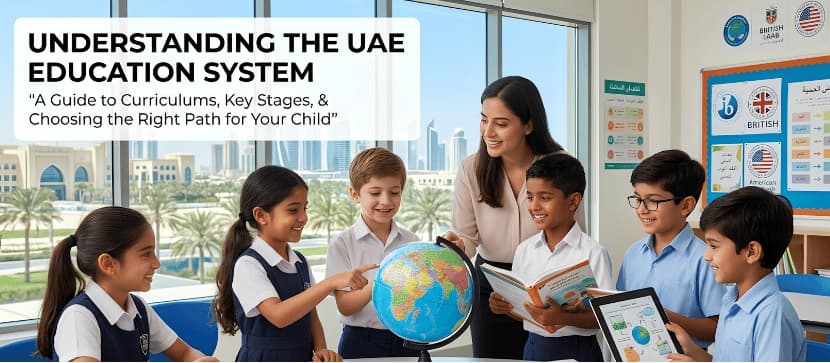
Quick Answer: The education system in the United Arab Emirates is built almost entirely around private schooling, with over 17 curriculums operating side by side, British, American, IB, and Indian being the most common. Schools are grouped into key stages by age, regulated by KHDA in Dubai and ADEK in Abu Dhabi, and rated annually on quality. Most expat families choose a curriculum based on where they expect their child to study next, not just the school closest to home.
Ask ten parents in Dubai which curriculum their child follows and you’ll likely get five different answers. That’s not confusion, it’s the design. Unlike most countries, where one national curriculum sets the pace for every child, the education system in the United Arab Emirates runs on parallel tracks, each with its own exams, calendar, and idea of what “ready for the next stage” looks like.
For a parent moving to Dubai or Abu Dhabi, this can feel less like choosing a school and more like choosing a schooling philosophy. Get the curriculum right early, and transitions between key stages feel smooth. Get it wrong, and you’re managing a mid-year switch that disrupts exam boards and grading systems. If you’re weighing up which path fits your child, Improve Me Institute’s curriculum guide breaks down each option stage by stage.
What Is the Structure of the Education System in the UAE?
The UAE education system is layered into two broad phases, primary and secondary, with each phase further split by curriculum and age groups. There is no single “UAE curriculum” that every child follows.
Government (public) schools teach the Ministry of Education’s national curriculum in Arabic, primarily serving Emirati nationals. Private schools, which educate the vast majority of the student population, follow international frameworks instead. The result is a system where the education system in United Arab Emirates functions more like a marketplace of accredited pathways than a single pipeline, a child can move from EYFS to A-Levels or the IB Diploma without ever touching the Emirati national syllabus, which is why understanding the primary curriculum options matters before you enrol.
What Curriculums Are Taught in UAE Schools?
This is the part that trips up most new arrivals. Dubai alone hosts schools running British, American, IB, Indian, French, and German curriculums — sometimes within the same neighbourhood. Here’s how the four most common ones compare:
| Curriculum | Typical Age Range | Final Qualification | Best Suited For |
| British | 3–18 | GCSE / A-Level | Families planning UK or Commonwealth university applications |
| American | 5–18 | High School Diploma / AP | Families planning US university applications |
| International Baccalaureate (IB) | 3–19 | IB Diploma / MYP | Families wanting a broad, internationally portable qualification |
| Indian (CBSE/ICSE) | 5–18 | All India Secondary School Certificate | Families planning to return to or study in India |
The British curriculum is the most widely taught model in the UAE, structured so each stage builds directly on the last. If your child is on this track, the jump from GCSE to A-Level is a defined, well-mapped transition rather than a guessing game. Families weighing the IB alternative can compare it against the IB curriculum directly.
How Are UAE Schools Structured by Age and Key Stage?
Regardless of curriculum, most private schools in the UAE organise learning into key stages that mirror the British model, since it’s the dominant framework in the market:
- EYFS (Early Years Foundation Stage) — ages 3 to 5, focused on play-based learning, early literacy, and social development
- Key Stage 1 — ages 5 to 7, where formal reading, writing, and number skills take hold
- Key Stage 2 (Lower and Upper) — ages 7 to 11, building core subject fluency ahead of secondary school
- Key Stage 3 — ages 11 to 14, the bridge year group before students choose exam subjects
- GCSE / IGCSE years — ages 14 to 16, leading to formal external examinations
- A-Level or IB Diploma years — ages 16 to 18, the final stretch before university
Each stage brings its own pressure points. A child moving from EYFS into Key Stage 1 is learning to sit still and follow structure for the first time — a different challenge from a teenager entering Key Stage 3, suddenly juggling six or seven subjects with real academic weight behind them.
Is Education in the UAE Mostly Public or Private?
Here’s the thing most people miss: the UAE’s public system exists almost entirely for Emirati citizens, taught in Arabic. Expat families, the overwhelming majority of Dubai’s and Abu Dhabi’s population, aren’t typically eligible to enrol, and even when they are, most choose not to.
That leaves private education as the default, not the alternative. Over 90% of students in Dubai are enrolled in private schools, according to KHDA’s own annual reporting, a strikingly high figure by global standards. It isn’t a premium option reserved for a few; it’s the standard experience, which is why families lean on structured, curriculum-aligned tutoring courses to keep pace with whichever system their child is in.
How Does the UAE Education System Compare to Other Countries?
In most countries, one ministry sets one curriculum and every school follows it. The UAE inverted that model deliberately, betting that competition between curriculums would raise standards faster than a single national syllabus could.
It mostly worked. School inspection ratings have climbed steadily over the past decade, and the country now hosts some of the highest-performing British and IB schools outside their countries of origin. But the trade-off is real: switching curriculums mid-way is far harder here than in a single-system country, since grading scales, subject sequencing, and the school calendar can differ entirely between an American-curriculum school and a British one. We’ve mapped out exactly how the UAE compares to other education systems if you want the fuller picture.
What Role Does KHDA Play in Dubai’s Education System?
The Knowledge and Human Development Authority — KHDA — is Dubai’s education regulator, and it does more than issue licenses. Every private school there is inspected annually and given a public rating: Outstanding, Very Good, Good, Acceptable, or Weak.
That rating is one of the most useful, most underused tools a parent has. Worth noting: the equivalent body in Abu Dhabi is ADEK (the Department of Education and Knowledge), which runs a similar but separate inspection framework, so a “Good” rating in Dubai isn’t directly comparable to a “Good” rating in Abu Dhabi. If terms like KHDA, ADEK, or inspection cycles are new to you, our education glossary is a quick way to get fluent in the vocabulary before school tours start.

How Can Parents Support Their Child Through the UAE Education System?
Picture this: your child starts Year 7, moving from one teacher for everything to seven subject specialists, each with their own homework rhythm. That shift alone causes a noticeable dip in confidence for many students, not because they’re behind, but because the structure changed faster than they could adjust to it.
Families who navigate this best do three things: understand which key stage their child is entering, stay close to the school’s curriculum framework rather than assuming “school is school,” and bring in targeted support before gaps become patterns. That’s where our secondary curriculum support or a structured entrance exam preparation course tends to pay off, not as a crisis response, but a way of staying ahead of the curriculum’s next turn.
If you’re also weighing up school choice, our 11+ consultation service is built for parents matching a child’s strengths to the right curriculum and entry point.
Frequently Asked Questions
Q: What is the education system in the United Arab Emirates based on?
A: Parallel private-school curriculums, British, American, IB, and Indian being the most common, rather than a single national syllabus. Public schools follow the Ministry of Education’s Arabic curriculum and mainly serve Emirati nationals.
Q: How does the UAE education system work for expat children?
A: Expat children almost always attend private schools, choosing British, American, or IB tracks based on family plans for university and future relocation. Enrolment is competitive at popular schools, so early registration matters.
Q: What’s the difference between KHDA and ADEK?
A: KHDA regulates and inspects private schools in Dubai, while ADEK does the same in Abu Dhabi. Both issue annual quality ratings, but the two aren’t directly comparable.
Q: Is the British curriculum common in the UAE?
A: Yes, it’s the most widely taught framework, running from EYFS through A-Levels, and it’s often chosen by families planning UK-bound university applications.
Q: How long does it take to switch a child between curriculums?
A: A mid-year switch can usually be managed within a term, though older students moving between very different systems may need a few months of targeted catch-up. Switching within similar Key Stages is smoother than switching across exam boards mid-cycle.
Q: Do UAE schools follow the same academic calendar?
A: No. It varies by curriculum, British-curriculum schools typically run September to July, while American-curriculum schools follow a similar cycle with different term breaks.
The Bottom Line
The education system in the United Arab Emirates rewards parents who treat curriculum choice as a long-term decision, not a first-year convenience. Once you understand how key stages, KHDA ratings, and curriculum pathways connect, the system stops feeling like a maze and starts looking like what it is: a set of well-marked roads, each leading somewhere specific.
Still narrowing down the right path for your child? Get in touch with our team, we work across every major curriculum in the UAE and can help map out the stage-by-stage plan that fits.