
Your child gets one run at this.We have done it before.
Jason Daswani guides Year 4, 5, and 6 families through Dubai’s secondary school entrance process — the exams, the applications, and the profile behind them. Every consultation begins with your child’s own reports on the table.

Jason Daswani
Co-founder and Head of Lower Secondary,
Improve ME Institute
- Dubai College alumnus
- BSc Mathematics, LSE
- Co-founder, Improve ME Institute
- Head of Lower Secondary, Years 7–9
This year’s entrance cycle
This year’s entrance cycle
- Applications open
- 7 September 2026
- Applications close
- 20 October 2026
- Entrance exam
- 10 November 2026
Indicative. Deadlines differ between schools — confirm each one directly.
The road to Year 7
Eighteen months, five moments that decide it
Almost every family we meet arrives at the same point on this line, a term later than they should have. Find your child on it, then read what is already fixed and what is still open.
Year 4
Build the base
Nothing is on the record yet. This is the cheapest time to fix a maths or English weakness, and the last point at which a new sport or instrument will have run long enough to mean something.
Year 5 · Term 1
The report that counts
The first report most secondary schools ask to see. From here, every grade your child earns is part of the application whether you intended it or not.
Year 5 · Summer
CAT4 and the shortlist
CAT4 separates what your child has learned from what they're capable of. Read next to the reports, it tells us which schools are a stretch, which are a fit, and which are a waste of a registration fee.
Year 6 · Autumn
Registration and papers
Applications close and entrance exams are sat, often within weeks of each other. At this stage marks are won on pacing and question triage far more than on new content.
Year 6 · Winter
Interviews and offers
Two children with the same paper score are separated by what they can say about themselves. This is where the years of clubs, teams, and reading either pay off or go unmentioned.
Not sure where your child sits? Send us their reports and we will tell you.
Who you’ll be sitting with
The exam is the last thing most consultants do for you. For Jason it is the first.
Jason Daswani co-founded Improve ME Institute and heads its Lower Secondary department — Years 7, 8, and 9. Those are the exact years your child walks into the September after the 11+.
He is also a Dubai College alumnus. He went through the same admissions journey your child is starting now, and grew up inside the school’s ethos — work hard, play hard, be civil and cooperative. He understands what they look for because he lived it.
Most of that process is opaque from the outside. His job is to make it plain — what each stage asks for, why it is weighted the way it is, and what your child should be doing about it now rather than in October.
That also means honest advice. He will tell you when to stop preparing as readily as when to start — and he is blunt about the schools where getting in is the easy part.
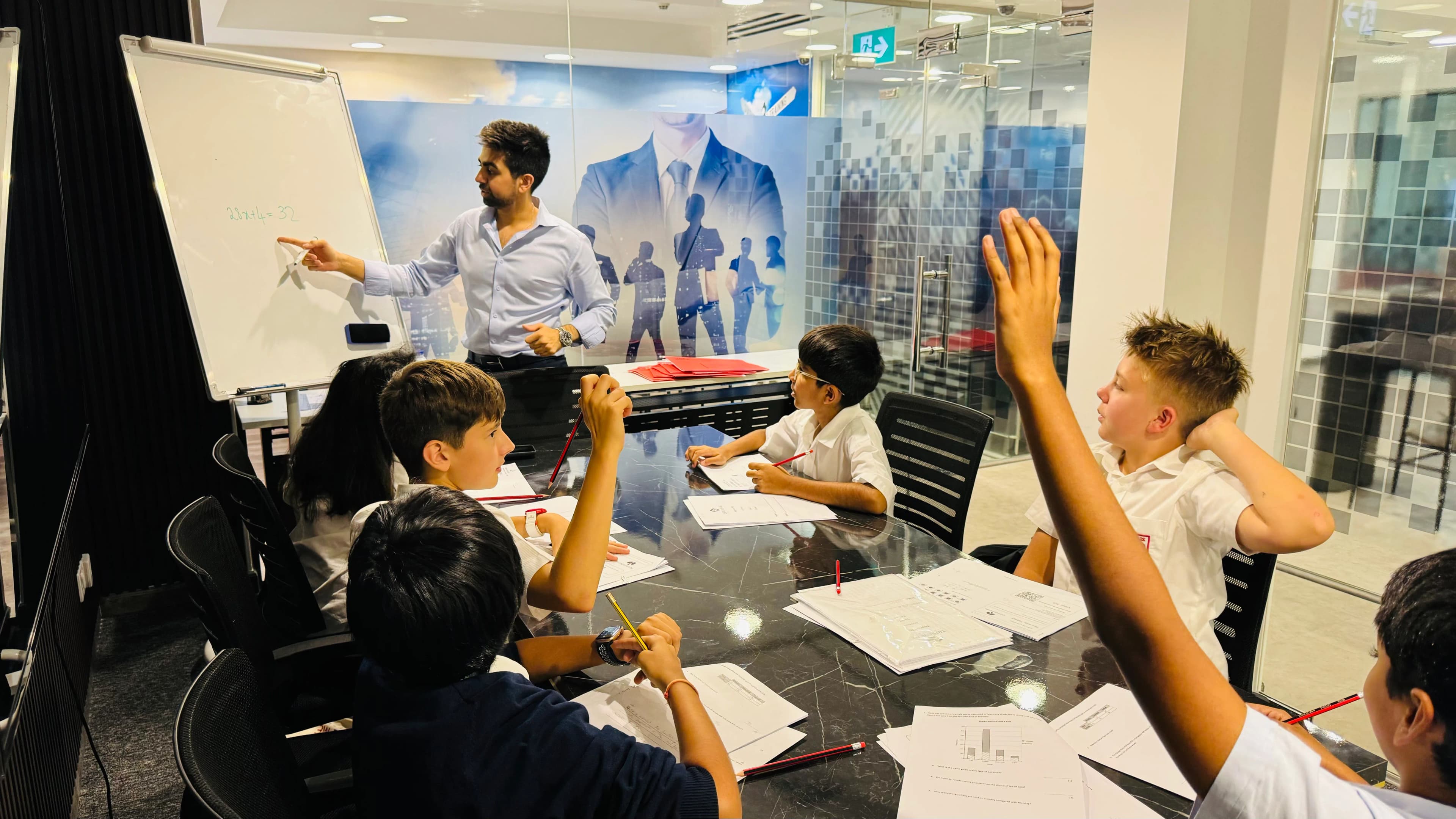
- 2010
- Family-run in Dubai since
- 40
- Faculty across the institute
- 30+
- Dubai schools served
- 11–14
- The ages Jason's department covers
Improve ME was founded by Jason’s mother, Neeta Daswani, and has been a licensed Dubai tutoring centre since 2010. His brother Shaun heads Upper Secondary. You are not hiring a consultant working alone — there is a department behind the advice, and it is the one your child would join.
Why families come to us
The exam is the part everyone prepares for. It is rarely the part that decides it.
By the time a family reaches us, most have worked out that their child needs to score well. What is less obvious is everything sitting around that score: which schools actually suit the child, how heavily each one weights the Year 5 report against CAT4, what an interview is really testing, and how a thin extracurricular record can undo a strong paper.
Jason went through all of it himself before reading Mathematics at the London School of Economics. He now spends his time on the other side of the desk — reading reports, sitting with parents, and saying plainly what he sees.
The aim is simple enough to state in a sentence: a child who walks into the exam properly prepared, and an application that represents them accurately.
What’s included
Six things every family gets
Personalised exam preparation
A plan built around your child's actual gaps, read from their reports and CAT4 profile — not a generic 11+ syllabus worked through front to back.
The ECA, written properly
We work through the form box by box and draft the wording with you, so nothing your child has done is left off and nothing on it is undersold.
A realistic shortlist
Which schools genuinely fit your child, which are a stretch worth taking, and which are a registration fee you will not get back.
Time management strategies
Most children lose marks to the clock, not the content. We drill pacing, when to skip a question, and when to come back to it.
Firsthand experience
Jason sat these exams and went through this process. He tells you the things a school prospectus never will.
One-to-one throughout
No groups and no rotating tutors. The person who reads your child's reports is the person who sits with them.
The ECA
Most parents meet the ECA for the first time the week it is due
Alongside the exam, schools ask for an ECA — a record of who your child is outside the classroom, set out across five areas. It is the part of the application almost nobody has seen before, and there is no second attempt at it.
Most families fill it in from memory over one evening, and half of what their child has actually done never reaches the page. We go through it with you box by box instead, and the things you had forgotten come out in the room.
Academic
Olympiads, maths and science challenges, science fairs, enrichment groups, reading awards. Every entry dated, and the placing stated whether or not it was a win.
Creative
Drama roles, music grades, art, design, coding and robotics. If your child played Peter in Peter Pan, that goes down as Peter — not as “school play”.
Philanthropic
Charity, community and environmental work. The easiest section to fill and the one most parents leave thinnest. Quantify it wherever you honestly can.
Sporting
Teams, squads, levels, captaincies, sports day. Breadth here counts for as much as one strong sport — schools are looking for a child who joins in.
Other
Leadership, languages, public speaking, debating, Model United Nations, and anything genuinely their own that the four boxes above don't hold.
Coming first, second, third — good, there is a medal for it. But putting your hand up and saying I want to be part of that is worth writing down too. Do not discount participation.
Date everything
An activity running since Year 1 says something a single entry never can. Longevity reads as real interest.
Strongest first
Nobody reads every box to the bottom. Each one opens with the entry you'd want read if they only read one.
Words the form rewards
Selected. Chosen from the year group. Represented. Accurate verbs that carry the weight the achievement actually had.
You leave with all five areas mapped, the gaps named, and a written plan you can actually work from — not a set of notes you have to decipher afterwards.
What it costs
Priced openly, booked one session at a time
There is no package to commit to and no minimum number of hours. You book the first meeting, and decide everything else afterwards.
- 2,000AED
Initial consultation
Parents onlyUp to approx. 1 hr 30 minJason reads the reports and CAT4 beforehand. You leave with a written plan and a realistic shortlist of schools. The meeting runs as long as your child's situation needs — usually up to an hour and a half — and meeting without them in the room lets us be direct about where they stand.
- 500AED / hour
Follow-up sessions
Your child joinsBooked as you need them, never sold as a package. Some families come monthly through the exam year; others book twice before an interview and that is enough.
- Free
Support between sessions
By email, unlimitedSend over a practice paper, a draft, or a letter from a school and Jason will come back to you. Questions do not wait for the next appointment, so neither does the answer.
Before we meet
Three documents to have ready
These are the papers secondary schools weight most heavily. Attach them to your enquiry and Jason will have read them before you sit down, so the hour goes on the plan rather than on catching up.
It also helps to jot down a few bullet points on your child’s extracurricular activities, so there is an outline to work from.
Document one
Year 5 first-term report
The earliest report schools ask for, and the picture of your child before any preparation began.
Document two
Most recent end-of-year report
Read next to the first, it shows direction of travel — which schools weight more heavily than any single grade.
Document three
Most recent CAT4 scores
The measure that separates attainment from potential, and shows us where there is genuine headroom.
“Jason and his team were exceptional throughout our 11+ journey, offering expert guidance and personalised support that made a huge difference. Their patience, tailored feedback, and encouragement helped build our confidence and our son’s readiness for the exam. We’re so grateful for their support and thrilled with the outcome.”
Parent of a Year 6 student · Dubai
Common questions
Before you book
If your question isn’t here, put it in the form below — we answer every enquiry ourselves.
- Why is the first session for parents only?
- Because it lets us be direct. The first meeting covers where your child genuinely stands, which schools are realistic, and how big the gap is — a conversation that is far more useful without a ten-year-old in the room. Your child joins from the follow-up sessions onwards.
- What year groups do you work with?
- Year 4 to Year 6. Families who come in Year 4 have the most room to build a profile; Year 6 families we support through the exams and interviews themselves.
- What if we don't have CAT4 scores?
- Bring what you have. CAT4 is the single most useful document, but the school reports alone are enough to start. If your child has not sat CAT4, we will tell you whether it is worth arranging.
- What is the ECA, and how much does it matter?
- It is the part of the application that covers everything outside the exam — your child set out across five areas: academic, creative, philanthropic, sporting, and other. Most parents have never seen one before, and it is where two children with near-identical scores stop looking identical. We fill it in with you rather than leaving you to it.
- Is a CAT4 score of 120 good enough?
- It is the question we are asked more than any other, and the honest answer is that there is no magic number. Parents arrive convinced a specific score is the cut-off and it simply is not how the decision is made. Last year's CAT4 is one input; how your child performs on the day carries more weight than a score they sat twelve months ago.
- Should we spend the summer drilling CAT4 papers?
- No. CAT4 practice is worth doing so the format holds no surprises, but it moves a score by a handful of points at most. What genuinely moves it is regular maths, regular English, and above all reading — a child does not go from 110 to 133 on practice papers alone. We would rather see an hour of reading than an hour of drilling.
- Can you guarantee a place at a particular school?
- No, and you should be wary of anyone who says otherwise. What we can do is make sure your child sits the exam properly prepared, applies to the right set of schools, and presents a profile that reflects them accurately.
- How quickly can we meet?
- We reply to every enquiry within one working day and usually offer a time that same week. If your child's exams are close, say so in the form and we will prioritise it.
Request a consultation
Tell us about your child
Attach the reports if you have them to hand — it means Jason arrives already briefed. We reply within one working day to confirm a time.
- We read the form and, if you sent them, the reports.
- We come back with two or three times that suit you.
- You meet Jason and leave with a written plan.