
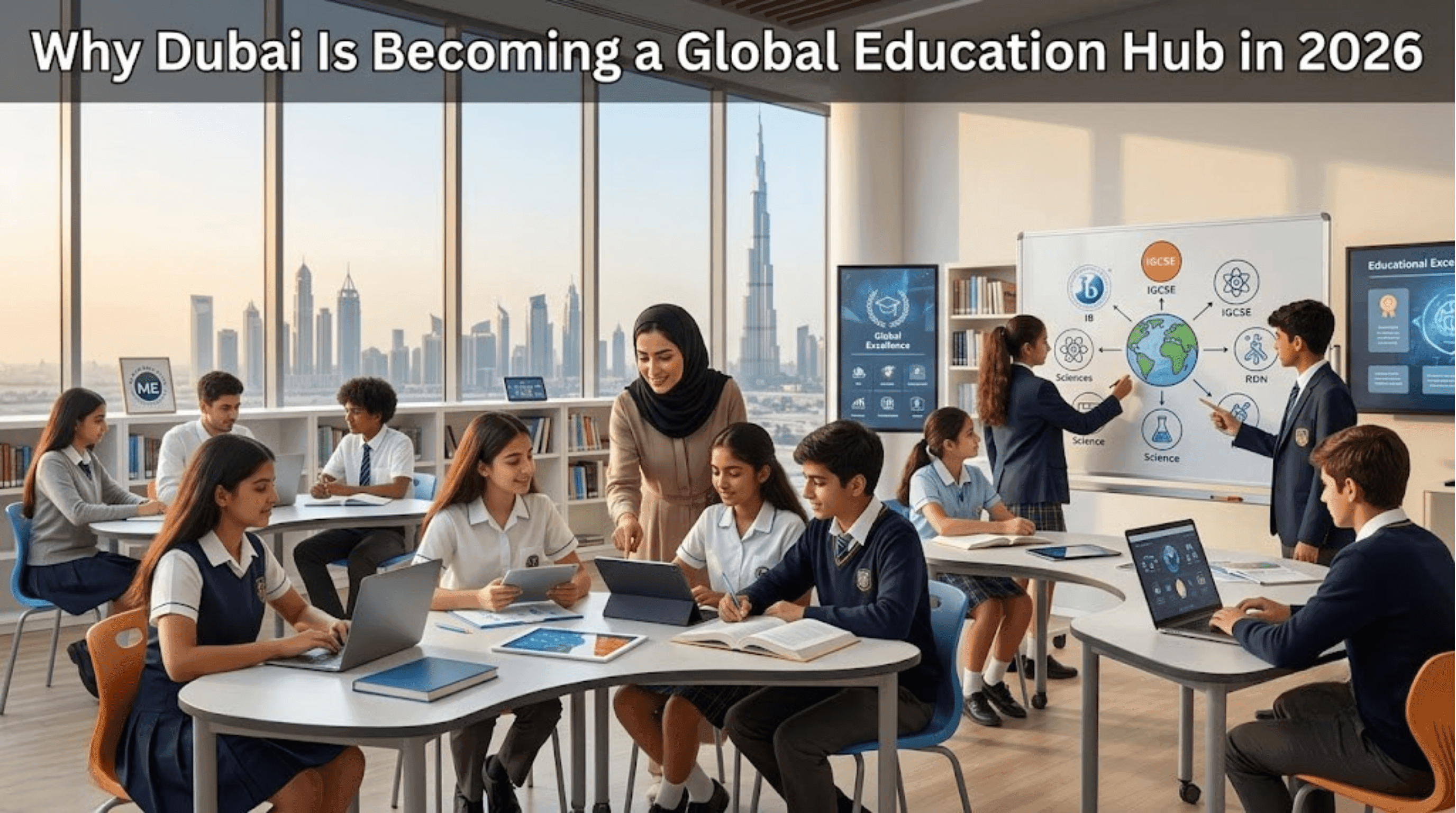
Quick Answer: Education in Dubai has grown into one of the world’s most competitive systems because the city combines British, American, IB, and Indian curricula under one KHDA regulatory umbrella, attracts qualified teaching talent from across the globe, and backs it all with heavy government investment. That mix of choice, oversight, and infrastructure is why education in the UAE is now benchmarked against London, Singapore, and Toronto rather than just regional neighbours.
Walk through any residential community in Dubai today and you’ll notice something that wasn’t true a decade ago: parents aren’t just choosing a school, they’re choosing a curriculum, an exam board, and often a university pathway year in advance. That shift is the clearest sign that education in Dubai has matured into a genuine global system rather than a convenience for expat families passing through. For a closer look at how families are approaching this decision from the very first years of school, Improve ME Institute’s primary school tutoring in Dubai page breaks down how curriculum choice at age five shapes options a decade later.
Regulation is the quiet reason this all works.
The Knowledge and Human Development Authority (KHDA) inspects every private school in Dubai annually and publishes the results publicly — something few education systems anywhere do with this level of transparency. Parents can compare “Outstanding,” “Very Good,” and “Good” ratings the same way they’d compare hotel reviews, which pushes schools to keep improving rather than coast on reputation. This accountability layer is also why licensed, KHDA-approved tutoring providers have become a trusted second layer of support. Improve ME Institute’s about page explains what that KHDA approval means in practice for a tutoring centre, not just a school.
Curriculum diversity is the second pillar.
Few cities on earth let a family choose between the UK National Curriculum, the American system, the International Baccalaureate, and Indian CBSE boards within a fifteen-minute drive. Dubai’s international schools serve well over 300,000 students across these systems, and the IGCSE has become the dominant qualification among British-curriculum schools specifically because it’s built for exactly this kind of internationally mobile student body. If your child is new to the emirate or transitioning between boards, the IGCSE tutoring Dubai programme is a useful starting point for understanding how Cambridge and Edexcel International differ, and what that means for exam preparation.
Teaching in Dubai has changed just as much as studying here.
A generation ago, teaching in Dubai meant a temporary contract and a tax-free salary. Today it means genuine career progression — schools compete for teachers with strong CVs from the UK, South Africa, Canada, and Australia, and salary packages increasingly include housing, flights, and school fees for teachers’ own children. That competition for talent has a direct knock-on effect on tutoring quality too, since many subject specialists split time between classroom teaching and small-group support. Improve ME Institute’s secondary school tutoring in Dubai page profiles the exam-board specialists working across KS3 through A-Level and IB, most of whom came to Dubai precisely because the teaching market here rewards specialism.
Here’s the thing most people miss: Dubai’s education boom isn’t only about schools — it’s about the ecosystem sitting around them. Government-backed free zones like Dubai Knowledge Park and Dubai International Academic City host branch campuses of universities including Heriot-Watt, Middlesex, and the University of Birmingham, meaning students can complete an entire British-style education from EYFS to undergraduate degree without leaving the emirate. That continuity matters enormously to relocating families, and it’s part of why structured early learning has become such a priority. The EYFS tutoring Dubai programme reflects this — building number sense and phonics foundations early, because schools here now expect a stronger baseline entering Year 1 than they did five years ago.
Subject specialisation is the trend most likely to define 2026.
Generic “homework help” has largely disappeared from serious tutoring providers, replaced by exam-board-specific instruction in Mathematics, the sciences, and increasingly Computer Science and AI Literacy. This mirrors what’s happening in Dubai’s classrooms, where schools are expanding STEM provision to match the emirate’s push toward a knowledge economy. Families looking for that level of specificity in mathematics, for instance, can see how Maths tutoring in Dubai is structured from EYFS right through to IB Higher Level, with diagnostic assessment used to pinpoint gaps rather than repeat classroom content.
And this is where it gets interesting for the sciences specifically.
Dubai’s ambitions in space, healthcare, and clean energy — Emirates Mars Mission, the Mohammed bin Rashid Space Centre, Masdar’s renewable energy work — have created real, visible career pathways that students can point to. That’s shifted demand toward rigorous science tutoring rather than just exam cramming. The Chemistry tutoring Dubai and Physics tutoring Dubai programmes both note something schools themselves rarely have room for: dedicated lab time for required practicals, which examiners increasingly weight heavily at GCSE, A-Level, and IB.

It’s worth being honest about the trade-offs, too.
Education in the UAE isn’t cheap — top private schools can run well above AED 80,000 a year, and competitive tutoring adds to that. Dubai also doesn’t have the decades of institutional history that London or Boston can claim. What it offers instead is speed: curriculum updates, teacher recruitment, and infrastructure investment all move faster here than in most legacy education systems, partly because government strategy documents like the Dubai 2040 Urban Master Plan explicitly name education as a growth pillar rather than treating it as an afterthought.
So why does all this matter to a parent deciding where to send their child, or a teacher deciding where to build a career?
Because Dubai in 2026 offers something genuinely rare — curriculum choice, regulatory transparency, and career opportunity all in the same city, at a scale most education hubs take generations to build. Families relocating mid-year, switching curricula, or simply wanting a second layer of academic support beyond the classroom don’t need to guess where to start. Book a free assessment with Improve ME Institute and get a clear, curriculum-specific plan for your child within a week — or browse the full range of tutoring courses in Dubai to see how the system fits together.
Frequently Asked Questions
1. Why is Dubai becoming a global education hub?
Dubai is becoming a global education hub because it offers a wide choice of international curricula, strong KHDA regulation, experienced teachers, modern infrastructure, and access to international universities. Families can choose between British, American, IB, and Indian curricula within the same city.
2. What curricula are available in Dubai schools?
Dubai schools offer several internationally recognised curricula, including the UK National Curriculum, IGCSE, American curriculum, International Baccalaureate (IB), and Indian CBSE curriculum. This gives families more flexibility when choosing a school based on their child’s academic goals and future university plans.
3. How does KHDA regulate education in Dubai?
The Knowledge and Human Development Authority (KHDA) oversees Dubai’s private education sector and regularly inspects private schools. Its published inspection ratings help parents compare schools based on teaching quality, student outcomes, leadership, and overall performance.
4. Is tutoring becoming more important for students in Dubai?
Yes. As Dubai’s schools become more specialised and students follow different exam boards and curricula, many families are turning to subject- and curriculum-specific tutoring. Support can range from EYFS and primary education to IGCSE, A-Level, and IB subjects.
5. Is Dubai a good place for international students and families?
Dubai can be a strong choice for international families because its education system offers globally recognised qualifications, multiple curriculum options, and pathways to universities around the world. Its growing education ecosystem also allows students to continue from early education through university without necessarily leaving the UAE.