Quick Answer: A workable homeschool schedule in Dubai puts the hardest subject early, keeps lessons in short blocks, and adds movement, revision and one small-group session each week. Most children need two to six focused hours a day, depending on age. Adjust for summer heat, Ramadan and exam dates.
Most homeschooling plans fall apart in week three, not week one. The curriculum is usually fine. The week simply has no shape.
Picture this: a family moves to Dubai in January, pulls their child out of a school that wasn't working, and copies the school timetable onto the dining table. By Wednesday the child is restless, the parent is refereeing, and Thursday's science lesson never happens. This guide is about the routine itself. If you're still weighing the whole idea, start with how homeschooling in Dubai works at Improve ME Institute, where each plan begins with a diagnostic.
How many hours a day does homeschooling really need?
Fewer than a school day. Schools spend a large share of the day on registration, transitions and whole-class waiting. One-to-one or small-group teaching removes most of that, so focused learning takes less clock time.
These are planning ranges, not rules. Treat them as a starting point and adjust after two weeks.
| Age and stage | Focused learning per day | What shapes the week |
|---|---|---|
| 5 to 7 (Key Stage 1) | 2 to 3 hours | Short bursts of 20 to 30 minutes, lots of play |
| 7 to 11 (Key Stage 2) | 3 to 4 hours | Daily reading and number fluency |
| 11 to 14 (Key Stage 3) | 4 to 5 hours | Core subjects plus a humanities block |
| 14 to 16 (Edexcel IGCSE) | 5 to 6 hours, including independent practice | Past papers increase before exams |
Older students can use the Pomodoro Technique, created by Francesco Cirillo: 25 minutes of work, 5 minutes off. Younger children usually need shorter blocks than that.
What does a realistic homeschool day look like?
Here's the thing most parents miss: the order of the day matters more than its length. In most cases, children concentrate best in the morning, so the subject that demands the most effort goes first.
A sample day for an 11- to 14-year-old:
| Time | Block | Why it sits here |
|---|---|---|
| 8:30 to 10:00 | Maths | Highest focus, hardest thinking |
| 10:00 to 10:30 | Break and movement | Resets attention |
| 10:30 to 12:00 | English reading and writing | Steady, language-heavy work |
| 12:00 to 1:00 | Lunch and outdoors | Real rest, no screens |
| 1:00 to 2:30 | Science or humanities | Lighter retrieval and discussion |
| 2:30 to 3:30 | Independent practice and review | Locks in the morning's learning |
| 4:00 onward | Small-group session or enrichment | Peer challenge, social contact |
Maths sits at the start because it's cumulative. A missed concept on Monday quietly breaks Thursday's topic, and morning energy gives a child the best chance of catching it.
How should subjects be spread across the week?
Daily contact beats long weekly marathons. Two hours of English on Friday does less than 40 minutes a day, because memory fades without repetition. Hermann Ebbinghaus described this forgetting curve in 1885, and it still explains why cramming disappoints.
A simple weekly pattern:
- Maths: every day, 45 to 60 minutes, with one block for error review
- English: daily reading, with extended writing on two days using the English skills your child needs most
- Science: two or three sessions, with practical or demonstration work on a fixed day through science tuition
- Humanities, languages and computing: one or two blocks each, rotated
- Enrichment on Friday: projects, plus modern skills such as AI literacy
Fixed days remove daily negotiation. Children argue less about a lesson that is simply "Tuesday's science."
How do you adapt the routine to Dubai's summer and Ramadan?
Dubai has a local wrinkle that generic homeschool guides ignore. From July to August, temperatures regularly pass 40°C, so outdoor time moves to early morning or after sunset. Lessons slide indoors during the midday peak, which actually suits the harder academic blocks.
Ramadan changes energy rather than curriculum. Many families move teaching earlier, shorten blocks and protect sleep. The American Academy of Sleep Medicine recommends 9 to 12 hours for ages 6 to 12 and 8 to 10 hours for teenagers, and a disrupted night quickly shows up in maths accuracy.
Movement matters all year. The World Health Organization advises an average of 60 minutes of moderate to vigorous activity daily for ages 5 to 17. In a hot city, that often means swimming, indoor sport or a mall walk, so schedule it rather than hoping it happens. A child who is flat or anxious may also benefit from structured wellbeing time, such as Inspire Wellness.
How do you build revision and exam practice into the week?
Start earlier than feels necessary. The research psychologist John Dunlosky and colleagues reviewed ten learning techniques in 2013 and rated practice testing and spaced practice as the most useful. Rereading and highlighting scored poorly.
That has a practical meaning for your timetable:
- Finish every week with a short quiz on the previous five days
- Return to old topics every two to three weeks, not just before exams
- For IGCSE students, add timed past papers from about six months out
- Mark against the official mark scheme, not by feel
Stress builds when revision arrives all at once, so these tips to manage exam stress are worth reading before the first mock. Students aiming at competitive courses can also plan ahead with university entrance exam preparation.

When does a small-group session beat learning alone at home?
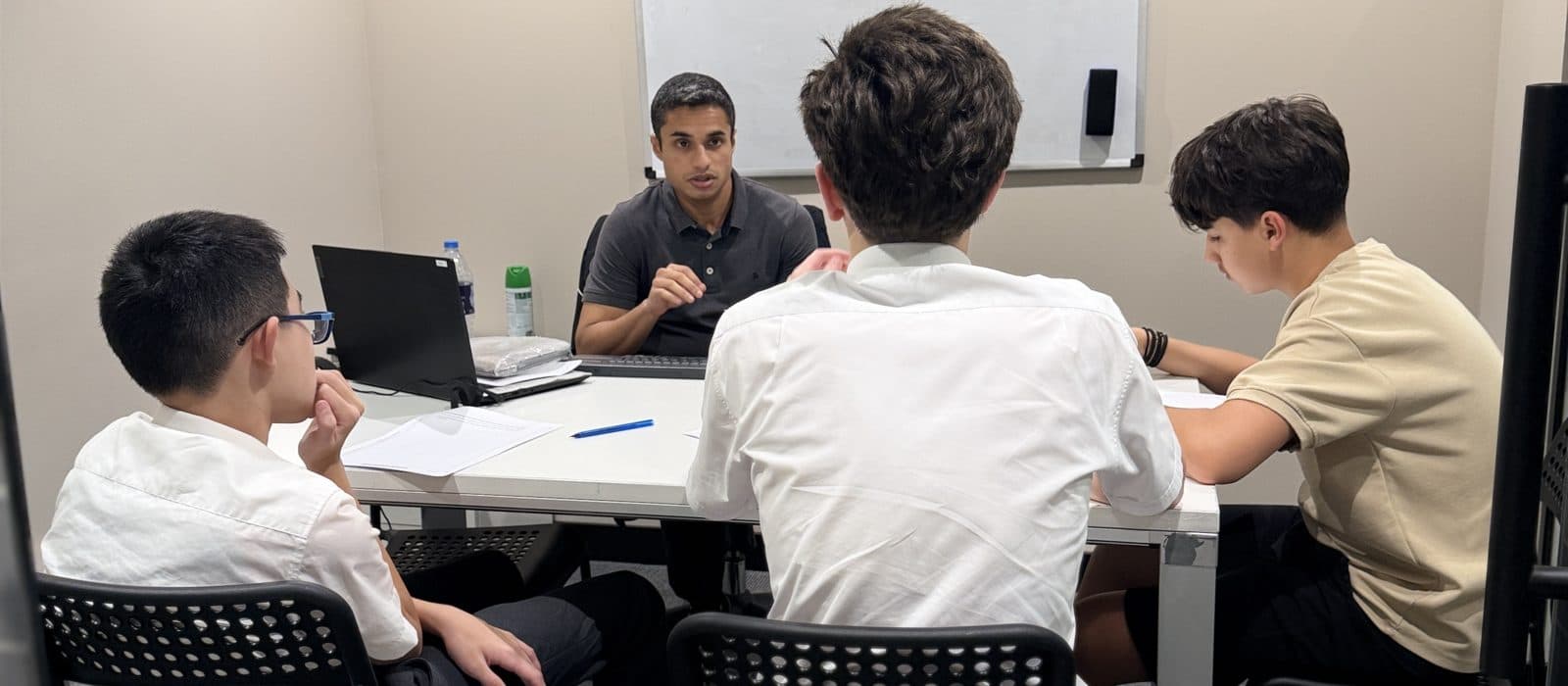
When your child is stuck, or when the day has no one to push back. A parent can explain a method. A teacher can spot that the child has misunderstood the question itself, which is a different problem.
Small groups also fix the loneliness gap. Hearing another student's approach, or defending an answer out loud, builds confidence that solo study rarely does. Our comparison of small-group vs one-to-one tutoring explains how to decide.
My view: every homeschooled child over eight should have at least one weekly session with other learners. It's the single cheapest change that makes the routine stick. Ask the academic team about weekly availability and session length before you build the timetable around it.
How do you start a homeschool routine mid-term without a rocky first month?
Ramp up instead of launching at full speed. A child leaving school often needs a few days to unwind, and forcing a six-hour day on week one is the fastest route to resistance.
A gentle first fortnight tends to work well:
- Days 1 to 3: Two short blocks, one maths and one reading. Talk through what they liked and disliked about school.
- Days 4 to 7: Add science and the afternoon review block. Keep the wake-up time steady.
- Week 2: Reach the full timetable for their age and book the first group session.
During this stretch, a diagnostic gives you facts rather than guesses about where your child stands. A nine- or ten-year-old may sit comfortably in Upper Key Stage 2 maths yet lag in writing, and a timetable should reflect that uneven profile. Expect a wobble around day ten. It's normal and usually passes once the rhythm feels familiar.
What mistakes break a homeschool schedule?
Three errors account for most failures:
- Copying school hours exactly. Seven hours at home usually means four hours of drifting.
- Overpacking week one. Burnout by Friday teaches the child to dread Monday.
- No feedback loop. Without checkpoints, gaps go unseen for months.
The fix for that last one is measurement. Regular assessments and teacher comments show what's secure and what isn't, which is why a free diagnostic test is the sensible first step. Screens deserve a plan too. Our guide to screen time and study time offers a workable balance, and educational counselling can help if the whole setup needs rethinking.
What else do parents ask about homeschool timetables?
Q: How many hours a day should a homeschooled child study?
A: Roughly two to three hours for ages 5 to 7, rising to five or six for IGCSE students. Quality matters more than length.
Q: What time should homeschool start in Dubai?
A: Most families begin between 8:00 and 9:00am. In summer and Ramadan, an earlier start often works better.
Q: Should the schedule be the same every day?
A: Keep the start time and order consistent and vary subjects across the week. Predictable rhythm reduces resistance.
Q: How do I know the routine is working?
A: Check that tests improve, your child finishes most blocks without a battle, and weekly reviews show fewer repeated mistakes.
Q: What if my child falls behind in one subject?
A: Add a short daily block for that subject for two to three weeks and re-test. If marks don't move, bring in a subject specialist before the gap compounds.
Q: Can I get answers about fees and arrangements?
A: Yes. The FAQ page is a good start, and the academic team can quote rates for your child's subjects.
Where should you start this week?
Don't rebuild everything on Sunday night. Pick a start time, put maths first, protect one hour of movement and book one session with other learners. Run it for two weeks, then adjust. A routine that feels slightly too easy at first usually lasts longer than one that feels ambitious.
If you want a second pair of eyes, book a free diagnostic at Gold and Diamond Park and bring your draft timetable.