
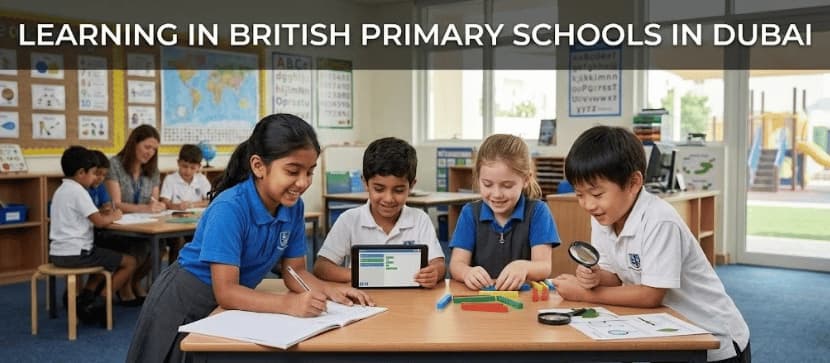
Quick Answer: Children at a British school in Dubai for primary education typically study core subjects — English, mathematics and science — alongside computing, humanities, creative subjects, physical education and personal development. Exactly what’s covered depends on the child’s year group, moving from the EYFS through Key Stage 1 and Key Stage 2, with each stage building on the last.
A Look at Primary Education in British Curriculum Schools
Ask ten parents what “the British curriculum” covers day to day, and you’ll get ten different half-answers. Most know it involves English and math’s. Fewer can say how a Year 2 timetable differs from a Year 6 one, or why a school calls a subject “computing” rather than “ICT.”
That gap matters because primary school sets the pattern for everything that follows. A child who leaves Key Stage 2 with solid reading, number sense and curiosity tends to walk into secondary school ready for it. One who’s been coasting doesn’t.
This guide breaks down what’s actually taught, year group by year group, at British curriculum schools in Dubai — the subjects, the skills that sit alongside them, and what parents should be watching for when they compare schools. If a subject gap turns up along the way, a free academic assessment is usually the fastest way to see exactly where a child stands.
Understanding the British Primary Curriculum in Dubai
The British curriculum followed in Dubai mirrors the National Curriculum for England, adapted for an international setting. It’s organized into stages rather than a single flat syllabus: the Early Years Foundation Stage (EYFS) for ages 3–5, Key Stage 1 (Years 1–2), and Key Stage 2, split into lower (Years 3–4) and upper (Years 5–6).
Each stage has its own learning goals, but they’re deliberately sequenced — skills from the EYFS feed directly into Key Stage 1, which in turn prepares a child for the more independent, subject-based learning of Key Stage 2. Here’s the thing most parents miss: a struggle in Year 4 often traces back to a gap that opened two years earlier and was never quite closed.
Dubai-based British schools also weave in UAE social studies and Arabic language requirements set by the KHDA, alongside the core English framework — so “British curriculum” in Dubai isn’t identical to a school in Surrey, even if the academic backbone is the same.
What Core Subjects Do Children Study?
Three subjects anchor every year of British primary education. They get the most curriculum hours, the most assessment of attention, and — not coincidentally — the most tutoring demand when things go off track.
| Subject | What It Covers |
| English | Reading, writing, spelling, grammar, vocabulary, comprehension and communication skills |
| Mathematics | Numbers, calculations, problem-solving, geometry, measurement and logical thinking |
| Science | Living things, materials, forces, the environment and scientific investigation |
English is arguably the subject that determines success everywhere else — a child who can’t confidently read a word problem will struggle in math’s, no matter how good their number sense is. Schools build this through phonics in the early years, moving into structured writing, grammar and comprehension work through Key Stage 2 English.
Mathematics in the British system is deliberately sequential: place value before long division, fractions before percentages. Skipping a step rarely goes unnoticed for long. Parents supporting a child through this can find year-specific detail on the primary mathematics curriculum page, and where extra practice helps, a dedicated maths course fills the gaps a classroom timetable doesn’t always have room for.
Science at primary level is less about memorizing facts and more about learning to ask good questions — why does ice melt, what do plants need to grow, how do magnets work. It’s hands-on by design, and it’s where a lot of children discover they actually like the subject before secondary school turns it more formal.
What Other Subjects Are Included in British Primary Education?
Academic subjects only tell half of the story. British schools built the rest of primary education around subjects that develop a rounder, more capable child — and these carry real weight in how a school is assessed and inspected.
- Computing and digital skills — basic coding logic, digital literacy, responsible technology use, and age-appropriate problem-solving. This groundwork increasingly overlaps with newer areas like AI literacy, which more forward-thinking schools and tutoring providers are starting to build early.
- History and geography — exploring people, places, historical events, cultures, communities and the wider world, usually taught as an integrated “humanities” block in the early years before separating later.
- Art, music and creative learning — self-expression, practical activities, and appreciation of different art forms, which matters more than it sounds; creative confidence at age 7 correlates strongly with willingness to take intellectual risks at age 14.
- Physical education — movement, coordination, teamwork and healthy habits, delivered through structured PE lessons rather than unstructured playtime.
Some schools round this out further with subjects like chess or financial literacy as enrichment options — not core curriculum, but genuinely useful for building strategic thinking and real-world number sense.
How Does Learning Change Across Primary School Years?
Lessons don’t stay in the same shape for seven years. They get more detailed and more challenging as children progresses, and — this is the part that catches parents off guard — the pace of that shift accelerates in the upper years.
In the EYFS, learning is largely play-based: structured but built around exploration rather than formal instruction. By Key Stage 1, children move into more direct teaching of reading, writing and number, though lessons are still short and varied. Key Stage 2 is where it changes gear. Lower Key Stage 2 (Years 3–4) introduces longer periods of sustained work and homework routines; upper Key Stage 2 (Years 5–6) pushes toward genuine independence — multi-step math’s problems, extended writing, and research tasks that expect a child to plan their own approach rather than follow a template.
That shift from foundational skills toward independence and critical thinking is exactly why so many families reach out for support around Year 4 and Year 5 — it’s the point where a child who relied on memorization starts to need actual reasoning skills instead.
How Do British Schools in Dubai Develop Skills Beyond Academics?
A good British primary education isn’t just measured in test scores. Schools are explicitly expected to build communication, collaboration, confidence, creativity, problem-solving, independence and social skills alongside the academic content — and these show up in how lessons are structured, not as a separate add-on.
Group projects teach collaboration in a way a worksheet can’t. Presenting a class builds communication and confidence at the same time. Open-ended problem-solving tasks in math and science build the kind of resilience that matters more, long-term, than any single test result. If a child seems academically fine but is quietly struggling with confidence or organization, that’s often exactly what a counselling and pastoral support conversation is designed to catch early.
How Is Student Progress Assessed?
Assessment in British primary schools happens continuously, not just at report card time. Common methods include:
- Ongoing classroom work and teacher observation
- Project-based assessments tied to specific units
- Periodic tests appropriate to the child’s age and stage
- Other age-appropriate formative assessments, such as reading records or portfolio work
It’s worth being honest here: not every British school in Dubai runs assessment identically. Some lean heavily on formal testing from Year 2 onward; others keep things more observational until Key Stage 2. Neither approach is inherently wrong — but it’s a genuine difference worth asking about at open days, because it affects how much pressure a child experience early on.
For parents who want an outside, objective read on where their child stands — separate from the school’s own internal grading — a free academic assessment gives a clearer picture than a report card alone usually can.

How Does the British Curriculum Prepare Children for the Next Stage of Education?
Strong foundations in literacy, numeracy and independent thinking don’t just help a child pass Year 6 — they determine how smoothly they handle the jump into secondary school. A child who’s genuinely comfortable with extended writing and multi-step problem-solving in Year 6 tends to find Key Stage 3 far less jarring than one who scraped through on memorization.
This is also where entrance exams start to matter for families. Children moving to selective schools, whether locally or abroad, often need targeted 11 Plus preparation well before Year 6 ends, and general entrance exam preparation covers the wider range of assessments UK-curriculum secondary schools use. Our guide on helping your child transition from primary to secondary school in Dubai goes into more detail on what that jump actually involves.
What Should Parents Look for in a British Primary School in Dubai?
Choosing a school is rarely a single factor. A few things are worth weighing carefully:
- Curriculum delivery — how EYFS, KS1 and KS2 content is sequenced, not just described in a prospectus
- Teaching approach — the balance between structured instruction and independent, inquiry-based learning
- Student support — how the school identifies and supports children who fall behind or who need stretching
- Extracurricular opportunities — sport, arts, coding, chess, debate — the things that build the “beyond academics” skills covered earlier
- Facilities and class environment — class sizes, resources, and whether the physical space supports the teaching style the school claims to follow
- Progression pathways — where graduates typically go on to, and how well the school’s own data backs that up
Our full breakdown of British curriculum schools in Dubai is a useful starting point for comparing options against these criteria directly.
Choosing the Right British Primary Education for Your Child
What children learn in British primary schools in Dubai isn’t a fixed list — it’s a sequence. English, math’s and science anchor the timetable; computing, humanities, art and PE round it out; and the whole thing is designed to build independence gradually, year on year, rather than all at once.
The real question for parents isn’t just “does this school teach the National Curriculum” — most do. It’s whether the curriculum, the teaching approach, and the support system actually fit how your specific child learns. That’s worth more than any prospectus can tell you, and it’s usually worth checking with a proper conversation rather than guessing.
Frequently Asked Questions
Q: What subjects do children study in British primary schools in Dubai?
A: Children study core subjects — English, mathematics and science — alongside computing, humanities (history and geography), art, music and physical education. The exact mix depends on the child’s year group, from EYFS through Key Stage 2.
Q: What is the difference between EYFS, Key Stage 1 and Key Stage 2?
A: EYFS (ages 3–5) is play-based and exploratory; Key Stage 1 (Years 1–2) introduces more formal teaching of reading, writing and number; Key Stage 2 (Years 3–6) builds toward independent, subject-based learning with longer, more challenging tasks.
Q: How is a British curriculum school in Dubai different from other curricula?
A: British curriculum schools follow a framework based on the National Curriculum for England, with additional UAE social studies and Arabic requirements. Our article on education system in UAE vs other countries explains how this compares to American, IB and Indian curricula available in the city.
Q: Is the British curriculum right for every child?
A: In most cases, yes — it’s structured, widely recognized internationally and sequenced to build steadily from EYFS onward. It suits children who benefit from clear progression, though families planning an international move should check how well it transfers, since some curricula transition more smoothly between countries than others.
Q: How can I tell if my child is on track for their year group?
A: The clearest way is a free academic assessment, which benchmarks a child against expected year-group standards independently of the school’s own grading, and flags specific gaps in English, math’s or science early enough to address them.
Q: When should I start preparing for my child for secondary school entrance exams?
A: Most families begin structured 11 Plus or entrance exam preparation in Year 4 or 5, giving enough runway to build exam technique without rushing the underlying skills in the final months before Year 6.